Driving Cultural Change through
Performance Management
What is Organisational Culture?
According to Flamholtz and Randle (2011)1, culture is about "corporate personality". It is concerned with the values, beliefs and norms which influence the behaviour of employees of the organisation. And Schein's model of organisational culture2 offers three distinct levels
- artefacts and behaviours - the dress code, the furniture, the visible elements of the culture.
- espoused values - the organisation's stated values and rules of behaviour.
- shared basic assumptions - deeply embedded, taken for granted behaviours which are unusually unconscious but constitute the essence of the culture.
When we talk of cultural change, we are exploring level 3 and one of the manifestations of organisational culture must be our approach to giving and receiving feedback, taking ownership for our own achievement of goals and reaching our potential.
Performance Management helps to support the realisation and adoption of the norms, values, and expectations of what is important both in terms of what things get done - and how things are done.
Performance Management: reflects and shapes culture
But if performance management is a reflection of the organisation's culture, it also has a role to play in shaping that culture.
Choosing which goals to set and monitor will help to bring about and reinforce the behaviours you want to see. It makes performance review a key part of behavioural - and therefore cultural - change. As such, your performance management process needs to be based on, and reflect, the set of beliefs, competencies and behaviours that truly helps your organisation to bring your values to life.
Traditional, once-a-year appraisal typically conjures up images of a valueless, isolated tick-box exercise with little relevance to the agile demands of the business. It is associated with forced rankings of employees, scores allocated behind closed doors, and a process that is 'done to' a person and with their participation. And these tend not to be elements of a culture that organisations want!
Organisations are recognising the importance of employee ownership of goal achievement and an open acceptance of feedback in the spirit of growth, development and change thereby extending the role of the manager to be more 'coach'. As a result:
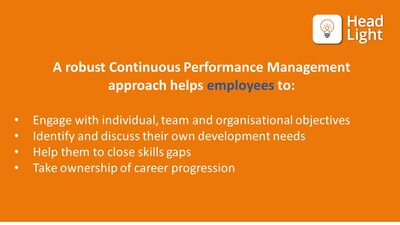
- Employees start to engage more with organisational goals, have a stronger understanding of their role in the business and take greater ownership of their development and career planning.
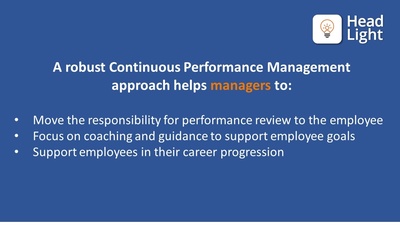
- Managers become more responsible for guiding their employees to achieve goals and objectives and in coaching them for career progression.
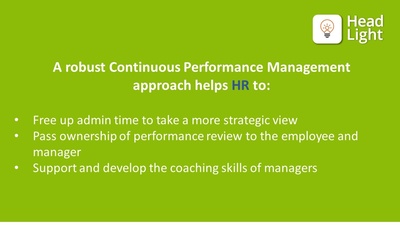
- The HR and talent team become less concerned with the detail and admin of talent activities and can spend more time supporting managers and taking a more strategic view of talent.
- Everyone gains the opportunity to understand the values and expectations of the organisation. They get to see how these are to be expressed in daily behaviours, communications and ways of working.
We'll take a look later in this eBook at the steps you need to drive this approach towards a more continuous performance management approach, but let's start by looking at how performance review is regarded right now.

References:
1 - Flamholtz, Eric G and Randle, Yvonne (2011), "Corporate Culture: The Ultimate Strategic Advantage," Stanford University Press, Stanford California, pp. 5–6 and 26–27.
2 - Schein, E.H. (2010). Organizational Culture and Leadership. Jossey-Bass.